


Magnetism is the characteristic of some substances pulling other substances toward themselves. This characteristic was first discovered by the Ancient Greeks on a mineral. At the beginning of 1920, William Hoke has discovered that the cracks found on metals could be determined via colored particles. It is obvious that magnetic particles to determine the magnetic flux lines on a magnetic field, for example field between the two magnetic poles of a magnet.
These magnetic particles are also used to determine the force lines on the external surfaces of a magnetic solid.
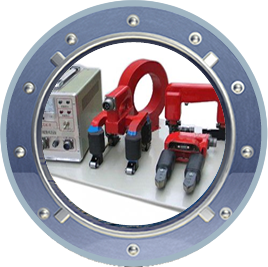
The discontinuity in the ferromagnetic materials can provoke sudden changes in magnetic permeability. These changes can be visible via the gathering at certain points of magnetic dusts disseminated on the piece. It is obvious that this dust will determine better the strong magnetic gradient. The applied filed should be vertical to the axe of the defect in order to obtain the biggest magnetic gradient around a defect. In other words, this method is a directional method. The piece to be examined via this method should be first becoming magnetic and then after examination removed from this magnetic field. It is possible to make the test piece becoming magnetic by three ways.
It is used to determine welding defaults in welding such as slag inclusions, pores, cracks, non-welding to side wall or insufficient penetration. Cast default, lamination, corrosion, thickness measurement is performed with this method:
The piece is put in a continuous magnetic or electromagnetic field.
The piece represents the bobbin core where a direct current passes.
A high ampere direct-current is given to the piece.
It is used to determine welding defaults in welding such as slag inclusions, pores, cracks, non-welding to side wall or insufficient penetration. Cast default, lamination, corrosion, thickness measurement is performed with this method:
The piece is put in a continuous magnetic or electromagnetic field.
The piece represents the bobbin core where a direct current passes.
A high ampere direct-current is given to the piece.

The visual and written contents found in this site have been provided by TİMGEMİ MÜHENDİSLİK.
All rights reserved 2011 ©
All rights reserved 2011 ©